Sayuri’s temporary exile from Gion
Memoirs of a GeishaSayuri’s temporary exile from Gion is the professional and social exclusion that follows Hatsumomo’s obstruction of her debut. With Hatsumomo able to reach Sayuri throughout the district and her ridicule threatening Sayuri’s reputation, Mameha tells her to return to the okiya; for the moment, the apprentice’s training continues while the public life she had expected is put on hold.
Cause and Immediate Exclusion
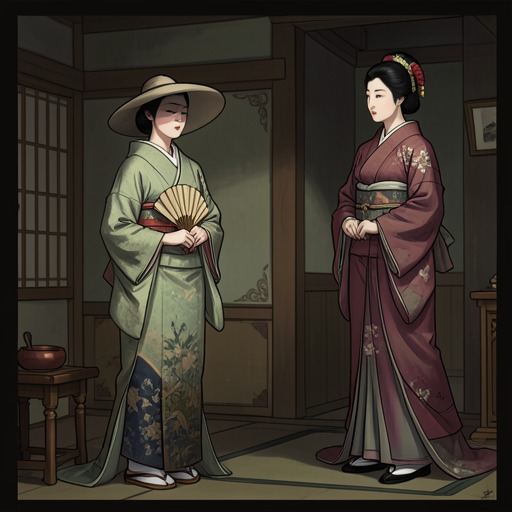
After hearing Hatsumomo spread a degrading rumor about another woman, Mameha and Sayuri leave the alley. Mameha looks up and down the street, unable to think of a place where they could go without Hatsumomo finding them. She concludes that Sayuri may as well return to her okiya until a new plan can be devised. The problem is not simply that Hatsumomo is nearby: her reach makes ordinary movement through Gion feel unsafe, closing off the district as a whole.
Mameha later gives Sayuri the blunt name for her position: she is an exile, for the moment. She hopes the setback will make Sayuri more determined to defeat Hatsumomo, but insists that following her around Gion will accomplish nothing until she has worked out a plan. Exile here means enforced withdrawal from the very social terrain where a young geisha’s reputation and professional prospects are formed.
Interrupted Debut and Reputation
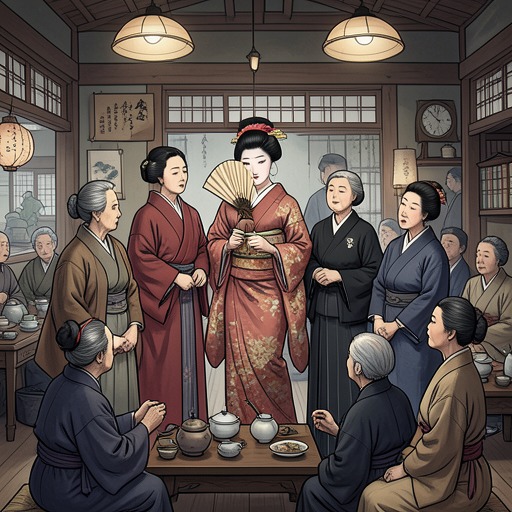
Sayuri had expected to be attending banquets every night, as well as ten or fifteen additional parties. Instead, she remains in the okiya practicing dance and shamisen, as if nothing had changed from the preceding year. The contrast makes the cost of exclusion concrete: she continues to train, but cannot convert that preparation into the public engagements that should have marked her debut.
Mameha explains that Hatsumomo’s ridicule could harm Sayuri in the eyes of men and women throughout Gion. Staying home is therefore not a retreat Sayuri chooses freely, but a precaution against damage to her standing. When Hatsumomo passes through the corridor in full regalia, her white makeup shining above her dark robe, Sayuri still recognizes her beauty but no longer envies it. The sight instead provokes hatred, with Sayuri hearing her own pulse hiss in her ears. Her perception of Hatsumomo has turned: the beauty that once inspired envy now belongs to the woman whose actions have stopped her debut.
Limits and Alternatives
The exile is serious but not absolute. Mameha is resourceful enough to find occasional engagements that are safe for Sayuri, and Hatsumomo cannot shut off the world beyond Gion. She takes Sayuri with her on a train trip to Kobe, where Mameha cuts the ribbon for a new factory, and on a limousine tour of Kyoto with the former president of Nippon Telephone & Telegraph. These outings do not restore Sayuri’s place in Gion, but they give her limited access to work and experience outside the district.
The Kyoto tour also alters Sayuri’s understanding of her own hardship. As they travel along the river south of the city, she sees impoverished women nursing babies beneath the trees beside the railroad tracks and men in tattered straw sandals among the weeds. Comparing their deprivation with the relative security of her life, she recognizes that even as a slave terrorized by Hatsumomo’s cruelty, she had been comparatively fortunate during the Great Depression. Her enforced distance from Gion thus brings an unexpected widening of perspective, even as it underscores how dependent her professional prospects remain on access to the district’s social world.
Significance
Sayuri’s exile suspends the outward progress of her apprenticeship without ending her training. Dance and shamisen continue inside the okiya, while banquets and parties—the public settings in which her debut should have taken shape—remain inaccessible. The state exposes the power of reputation in Gion: Hatsumomo can restrict Sayuri’s opportunities not by stopping her lessons, but by making her presence socially dangerous.
At the same time, Mameha’s occasional engagements beyond Gion keep the exclusion from becoming total. The episode holds confinement and a limited enlargement of experience together: Sayuri is pushed away from the district where she hopes to establish herself, yet the journey beyond it reveals a city and a degree of poverty she had not previously understood.